Friday, 29 June 2018

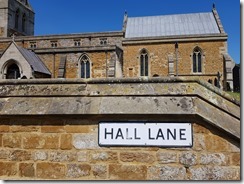
THE CHURCH OF ST MARY THE VIRGIN ASHLEY

5STARS


A very beautiful church in a very nice village, please visit it!!!


image

Email: events@ashleychurch.co.uk  www.ashleyvillage.co.uk

EARLY HISTORY

Little definite information is available about the early history, but support for the existence of a building of quite early date is found in the records. In 1189 AD in the reign of Richard I, 'half of the patronage of Ashley Church was given to Pipewell Abbey' by Peter de Ashley. This indicates the existence of a church in the 12th century. According to Pevsner, material re-used in Gilbert-Scott's re-modelling in the 19th century would suggest a date of around 1300. However, taking into account the siting of the church on the highest point of the village, an earlier building, perhaps of wood with a thatched roof may have stood in late Saxon or early Norman times, later to be re-built in stone.

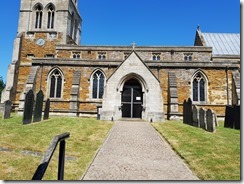
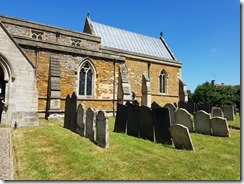
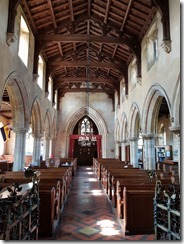
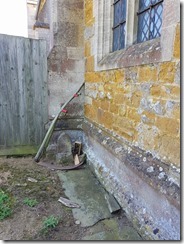
The church is a Grade I Listed Building. It is built of ironstone and grey limestone in courses, with dressings and quoins. It is dedicated to the Blessed Virgin Mary and today consists of chancel, vestry, and nave with north and south aisles, south porch and tower surmounted by a lofty and graceful broach spire. The tower has a corbel-table of seven heads, beneath which are displayed stone tablets containing coats of arms, one of which is that of the Bassett family. Richard Bassett was Chief Judiciar of England in the 12th century, being second only to the King. He founded Launde Abbey in 1119 and was associated with the neighbouring village of Sutton Bassett.

The oldest surviving part of the church is thought to be the south doorway and here the typically Norman decoration of dog's-tooth moulding can be seen in the hood-mould over the door-way. Inside there is evidence of a lady- chapel (1) or confessional in the south transept of the nave, which has a wide east-facing window in the Decorated style, flanked by two early carved heads, which may have been supports for some structure now lost. There is a small piscina close by, in the south wall of the aisle. The windows of the nave and clerestory are in decorated style, and the piers are of quatre-foil form, simple and undecorated.

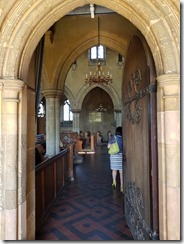
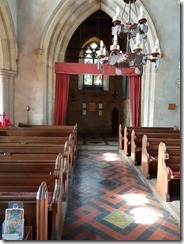
The decoration of the nave is starkly plain with an unrelieved harled finish (fibre of flax or hemp) to the walls. The flooring is plain tiles, laid in a diaper pattern of red and black.

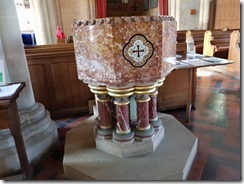
The font (2) is situated in the usual place, near the main door of the church. It is a rather heavy, ponderous affair of pink-mottled Italian marble, hexagonal in form and raised on short marble pillars with gilded bases and capitals. It was given to the church by the rector of the time,

Rev Richard Thomas Pulteney and is said to have cost £2000 in 1857! An earlier, simple but elegant font (3) now stands in the chancel.

19th century restoration

Restoration and refurbishment took place in 1864 when the wealthy rector, Rev Richard Thomas Pulteney, called in the eminent architect Sir George Gilbert Scott. Pre-restoration drawings by George Clark suggest that, chancel apart, Sir George followed closely what was already there, confining himself to repair and restoration, re-flooring the nave, replacing box pews with benches, and providing new heating and lighting systems. But for the chancel it was a different story, and today the chief glory and interest of the church lies in the work which was done in this 1864-66 transformation. The exterior was almost entirely re-built, re-using much of the ancient stone and at the same time the chancel was lengthened and heightened, thus creating large wall and ceiling areas to take the decoration planned for it. The designs were the work of Messrs Clayton and Bell and the theme was the Te Deum Laudamus. Groups of figures taken from this anthem and illustrating verses from it, cover the walls.

Thus the north wall depicts "The glorious company of the noble apostles" and the south wall has "The goodly fellowship of the prophets. On the west wall are depicted the "Saints" and "The noble army of Martyrs"

The barrel-vaulted ceiling is divided into two sections, that immediately above the altar being painted in blue with silver stars, representing the vault of heaven, while the larger western part is divided into large patterned squares reminiscent of the style of decoration found in many mediaeval buildings. The whole is lavishly enhanced with gold-leaf and emphasised by wide ribbon-like borders in many colours, producing an effect of sumptuous richness and splendour. The triple-arched opening in the north wall (4) has pillars of grey-pink marble, their bases and capitals highlighted in gold leaf. The treatment of the sanctuary area is particularly lavish. The reredos (5) of carved and inlaid alabaster is composed of five cusped arches, surmounted by tall pointed canopies with gilded crockets.

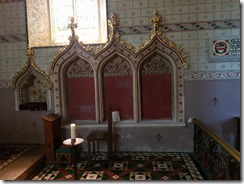
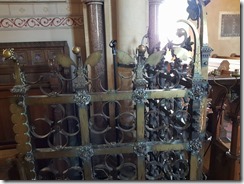
The central space is inlaid with a cross of blue enamel and the whole is lavishly ornamented with gold-leaf. On either side of the altar-table the walls are faced with twin-arched panels of alabaster with slender columns painted and gilded. The flooring of the sanctuary is in a pattern of various coloured marble tiles and that of the main part of the chancel is in encaustic tiles of dark red and green. There is a piscina and triple-arched sedilia (6) on the south wall, both having received similar decorative treatment. There are also brass chancel screens and decorative chancel rail. The fine oak choir stalls were introduced into the chancel at this time. Originally both the vestry and the organ loft were decorated in the same way, but owing to the high cost of the restoration of the chancel in 1973, it was decided not to try to restore them but to treat them only to simple repainting. A fragment of the original patterning can still be seen however on the north wall of the organ-loft, behind where the organ originally stood, before being moved to its present position.

The organ (7), whose decorative painted and gilded case is in the same High Victorian style as the chancel decoration, was made by Bryceson of London and installed in 1867. For long it was thought to be the work of Sir George Gilbert Scott himself, but is more likely to be the work of his son George Gilbert Scott.

FURTHER RESTORATION

In 1973 the wall-paintings and ceiling of the chancel were cleaned and repainted where necessary, using identical paints, and much of the gold-leaf was restored. The work was carried out by Peter Larkworthy of Baldock, great grandson of Arthur Bell. At this time also the chandeliers (Bodley) in the nave were re-painted in a colour which blended with that of the chancel walls, the vestry and organ loft. They were converted to electricity in 1993 when the re-wiring of the church was undertaken.

In 1991 the Quinquennial Survey conducted by Gotch Saunders and Surridge indicated that the stonework of the tower and spire had deteriorated and E. Bowman & Sons of Stamford carried out the necessary work during 1994.

PATRONS AND MONUMENTS

Patrons

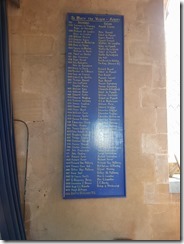
Inside to the left of the entrance door hangs a board (8) containing a list of patrons and incumbents from 1220. Incumbents were under the patronage of the Abbots of Pipewell Abbey, who were patrons of Ashley church on and off until 1504. Friars from the abbey would be sent to conduct services. The patron of the church in 1329 was the king himself, King Edward III.

After the Dissolution of the Monasteries, around 1538, the moiety of the church was divided between Sir Ralph Sadler and Lawrence Wymington (Knight). This later passed to the Templer family.

Monuments.

Rev R Farrer died 1852 - within the altar precincts on north wall

Richard Farrer, Rector for 36 years died 1809 on north wall of chancel

Arthur Wykeham Pulteney (son of Rev R T Pulteney) Rector for 43 years, died 1927. This is a painted and decorated stone plaque.

A companion plaque has George Reg Lascelles CVO QBE Lt Col, Coldstream Guards died 1939 aged 41 years.

In the organ loft on the north wall is a brass plaque to Ann died 1828, John died 1889, Joseph died 1871 and Thomas Elliott.

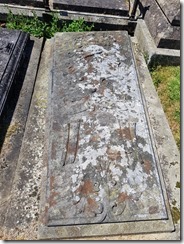
Running down the centre aisle of the nave, let into the tiled floor diamond-wise, to echo the diaper pattern of the tiling, is a series of brass memorial plates. They are all of one size pattern and style and have obviously been made as a set for the purpose of decoration as well as memorials, being evenly spaced from the chancel step to the tower opening. These are engraved with the names of John Maidwell 1695, Elizabeth Mason, his daughter 1760, Edward Maidwell 1698, Wm Wade and wife Mary 1779 and 1800, George Wignell 1685 and Grace Wignell 1653. They were no doubt introduced by Gilbert Scott in the 1865 re-flooring of the nave.

On the south wall of the south aisle is a marble plaque dedicated to the memory of William Berry of the 7th Company of Yeomanry who was killed in action near Biddulphsberg, Orange River Colony on 29th May 1900, aged 22 years.

The War Memorial (9) is on the south wall of the south aisle and bears the names of five Ashley men killed in the Great War of 1914-1918: Otho Crain, Omar Gray, Albert Hammond, Frederick Neal and William Payne. Below on the same memorial is the name of Alistair Slater of the SAS, who was killed in Northern Ireland on 2nd December 1984.

STAINED GLASS

The east window of the south aisle of the nave depicts the story of Cain and Abel and also the re-naming of Jacob as "Israel"'. It is dedicated to Richard Pulteney.

In the vestry is a 'musical' window which shows David with his harp and St Cecilia at the organ.

In the sanctuary, the east window has scenes from the life of Christ, including his crucifixion.

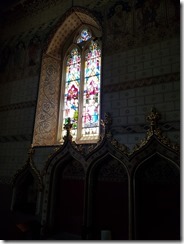
On the north wall of the chancel the window has scenes showing the raising of Lazarus and other miracles.

On the south wall of the chancel are scenes depicting the "Upper Room" and St Peter's communion.

All these windows were designed by Messrs Clayton and Bell working under the direction of Sir George Gilbert Scott in 1867.

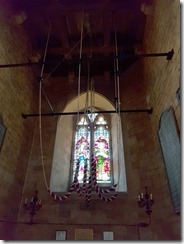
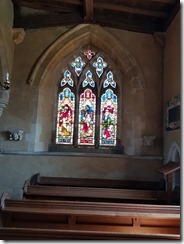
Lastly the colourful west window in the tower, showing the Purification of
the Virgin Mary, was given by Henry Morgan Vane in memory of his wife
who died on 16th December 1878.

BELLS AND CLOCK

As the year 2000 approached and it was announced that the new millennium would be ushered in by the ringing of church bells, attention turned to the bells which had not been rung "full-circle" for many years.
Again grants were sought and fund-raising took place so that the five bells could be over-hauled and re-hung by Hayward Mills & Associates of Nottingham. Three of the five bells were cast by Robert Taylor of St Neots in 1796, the tenor bell was cast by John Taylor of Loughborough in 1848, and number three bell is a rare alphabet bell cast in 1595 by Hugh Watts of Leicester. A Service of Rededication of the bells was held on Sunday 4th February 2001, conducted by the Bishop of Brixworth, and followed by a full peal.

At this time also it was decided to electrify the clock which for many years had been wound by hand on a weekly basis. The clock was made by J B Joyce & Co of Whitchurch in 1866 and the work to convert it to an auto- wind system was carried out by John Smith & Sons of Derby in September 2001

image


SOME PICTURES:
Resize of 20180628_123423Resize of 20180628_123501Resize of 20180628_123520Resize of 20180628_123530Resize of 20180628_123604Resize of 20180628_123635Resize of 20180628_123648Resize of 20180628_123703Resize of 20180628_123735Resize of 20180628_123749Resize of 20180628_123806Resize of 20180628_123814Resize of 20180628_123821Resize of 20180628_123830Resize of 20180628_123839Resize of 20180628_123848Resize of 20180628_123900Resize of 20180628_123908Resize of 20180628_123916Resize of 20180628_123943Resize of 20180628_124000Resize of 20180628_124008Resize of 20180628_124042Resize of 20180628_124049Resize of 20180628_124306Resize of 20180628_124331Resize of 20180628_124347Resize of 20180628_124427Resize of 20180628_124507Resize of 20180628_124529Resize of 20180628_124652Resize of 20180628_124908Resize of 20180628_125154

Sunday, 10 June 2018

Lungi dal volere determinare con certezza il significato dell'epistola di Nostradamus al Re Enrico II vorrei utilizzarla almeno per capire i prossimi eventi cosi' come cronologicamente il veggente di Salon li avevi percepiti e stesi in un certo ordine che non fosse quello astruso usato nelle piu' famose quartine.
Riporto la trascrizione dall'originale 1568 pubblicata da Rigaud e una approssimativa traduzione in Italiano.

[LI] & de la iusques icy, & sera au moys d'octobre que quelque grâde translatiô sera faicte, & telle que l'on cuidera la pesanteur de la terre auoir perdu son naturel mouuement, & estre abismee en perpetuelles tenebres, seront precedens au têps vernal, & s'en ensuyuant apres d'extremes châgemens, permutations de regnes, par grand tremblement de terre, auec pullulation de la neufue Babylonne, fille miserable augmentee par l'abomination du premier holocauste,
(LI) - e da quel tempo fino ad ora, ed avverrà  nel mese di ottobre, che qualche grande cambiamento sarà  fatto, tale che si crederà  che la terra abbia perduto il suo naturale movimento e si stia inabissando nelle tenebre eterne; il tempo invernale avanzerà  e seguiranno estremi cambiamenti, mutazioni di. regni, grandi terremoti, pullulazione della nuova Babilonia, miserabile figlia, ingrandita dalla abominazione del primo olocausto,

[LII]  & ne tiendra tant seulement septante trois ans, sept moys,
(LII) - e durerà  soltanto 73 anni e 7 mesi,

[LIII] puis apres en sortira du tige celle qui auoit demeuré tant long têps sterille, procedât du cinquantesme degre, qui renouuellera toute l'Eglise chrestienne.
(LIII) - poi uscirà  dallo stelo quella che era stata cosi a lungo sterile, procedendo dal cinquantesimo grado, che rinnoverà  tutta la Chiesa Cristiana.
Fino a questo punto, nel passo [LI] e [LII], possiamo scorgere chiaramente la rivoluzione Russa con il comunismo che durera per l'appunto 73 anni:
Dal 9 gennaio 1917, anno della Rivoluzione di Ootobre al 1989, anno della dissoluzione dell'U.R.S.S.
https://it.wikipedia.org/wiki/Storia_del_comunismo
https://it.wikipedia.org/wiki/Dissoluzione_dell'Unione_Sovietica
Il passo [LIII] indica invece come la chiesa partendo dalla Polonia con il Papa Giovanni Paolo II si sia rinnovata nei paesi dell'est.

Passiamo al presente ed al prossimo futuro:

[LIV] Et sera faicte grande paix vnion & côcorde entre vns des enfans des fronts esgarez, & separez par diuers regnes
(LIV) - Sara'  fatta una grande Pace, unione e concordia tra uno dei fanciulli dei fronti sconvolti e separati dei diversi regni;

[LV] sera faicte telle paix que demeurera attaché au plus profond baratre le suscitateur & promoteur de la martiale faction par la diuersité des religieux, & sera vny le royaume du Rabieux: qui côtrefera le sage.
(LV) - e sarà  fatta una tale pace che rimarrà  appeso al più' profondo baratro il suscitatore e promotore della fazione di guerra per la diversità  delle religioni e sarà  riunito il regno del Rabbioso che imiterà il saggio.

[LVI] Et les côtrees villes, citez, regnes, & prouinces qui auront laissé les premieres voyes pour le deliurer, se caftiuant plus profondement seront secrettement laschez de leur liberté, & parfaicte religion perdue, commenceront de frapper dans la partie gauche, pour retourner à la dextre,
(LVI) - E le contrade, città , paesi, regni, e province che avranno per prime le vie per salvarsi, rendendosi ancor più prigioniere, saranno segretamente private della loro libertà  e, perduta la perfetta religione, cominceranno a colpire a sinistra, per ritornare a destra,

[LVII] & remettant la saincteté profligee de long temps, auec leur pristin escrit, qu'apres le grand chien sortira le plus gros mastin, qui fera destruction de tout, mesmes de ce qu'au parauât sera esté perpetré, seront redressez les temples comme au premier temps, & sera restitué le clerc à son pristin estat,
(LVII) - ristabilendo la santità  sconfitta da lungo tempo con la loro antica scrittura, cosi' che dopo il grande cane, sorgerà  il più' grosso mastino che tutto distruggerà , anche ciò' che prima era stato perpetrato, verranno ricostruiti i templi come nei tempi remoti, e sarà  restituito il clero al suo primitivo stato,

Il passo [LIV] e [LV], rappresente la fine della guerra fredda, e la pacifica evoluzione della Germania indicata come regno del rabbioso (Hitler), il passo [LVI] e [LVII], secondo la mia soggettiva interpretazione, rappresenta lo stato attuale delle politiche Europee, che oscillano da sinistra a destra ed a causa della propria incapacita nel gestire la liberta e la scusa della sicurezza  finira' con il privare della liberta i cittadini, dando luogo alla nascita di un nuovo dittatore che ci portera' nel baratro per la terza volta in poco piu' di cento anni.


Mario

Monday, 25 July 2016

The end of Western civilisation

http://www.un.org/en/development/desa/population/publications/ageing/replacement-migration.shtml
United Nations Population Division, Replacement Migration

The present study considers countries in which current fertility ranges from 1.2 to 2.0 children per woman.    For  France,  the  United  Kingdom,  the  United  States  and  the  European  Union,  the  number  of migrants needed to offset population decline is less than or comparable to recent past experience.  While this is also the case for Germany and the Russian Federation, their migration flows in the 1990s were relatively  large  due  to  reunification  and  dissolution  respectively.    In  contrast,  for  Italy,  Japan,  the Republic of Korea and Europe, a level of immigration much higher than that experienced in the recent past would be needed to offset population decline.  As a result of this higher level of immigration for Italy, Japan and Europe, 18 to 29 per cent of the 2050 population would be post-1995 immigrants and their descendants; for the Republic of Korea, the comparable figure is 3 per cent.
 
THIS IS AN EXCERPT FROM THE U.N. RESEARCH ON REPLACEMENT MIGRATION, BECAUSE IT SEEMS NOBODY CARES ABOUT IT, IT MEANS, THAT AROUND 500,000 IMMIGRATES PER YEARS WILL BE NECESSERY FROM TODAY TO THE YEAR 2050, PLEASE WAKE UP!

Friday, 22 July 2016

C10Q60

Second hit for this quatrain….


C10Q60

Je pleure Nisse, Mannego, Pize, Gennes,
Savone, Sienne, Capue, Modene, Malte:
Le dessus sang & glaive par estrenes
Feu, trembler terre, eau, malheurueuse nolte.
-----
I weep for Nice, Monaco, Pisa, Genoa,
Savona, Siena, Capua, Modena, Malta:
For the above blood and sword for a New Year's gift,
Fire, the earth to tremble, water, unfortunate nolition.

Variantes avec les autres éditions consultées
1558: Capuë — Modene
1568:Modene .
1644: Capuë, Modene
1694: Savonne — Capuë, Modene — glaive par étrennes
Traduction littérale
Je pleure Nice, mer Noire, Pisé, Gênes, Savone, Sienne, Capoue, Modene, Malte: Le dessus sang, et glaive par étrennes,
(étreintes) Feu, trembler terre, eau, malheureuse note.
Quelques interprétations avancées
Les deux Fontbrune y voient l'invasion de l'Italie, la côte méditerranéenne, les tremblements de terre, lors de la troisième guerre mondiale. Laroche-Valmont et John Hogue épousent allègrement l'hypothèse de la Djihad islamique qui peindrait dès 1999.
Mireille Corjava y voit l'épisode de la Seconde Guerre mon​diale où les raids aériens frappèrent la plaine du Pô et la région bordant la mer Tyrrhénienne, jusqu'à Malte. De véritables ava​lanches de bombes (les «estrennes» dont il parle) larguées sur toute cette zone, faisant trembler le sol, agitant l'eau de la mer et anéantissant aveuglément les vies et les biens des habitants qui ne combattaient pas. Louis Shlosser y voit le périple du mage de Salon en Italie en 1543. Serge Hutin pense qu'il s'agit de l'Empire français obligé, en 1814, d'abandonner toutes les belles conquêtes napoléoniennes en Méditerranée. Pour Cheetham, cela fait allu​sion aux temps derniers. Lemesurier pense également à cette invasion de l'Europe par les forces islamiques et pense que ce quatrain concernerait les années 2000 à 2005.

Mario

From Jean Guernon's book

Friday, 15 July 2016

NOSTRADAMUS AND THE COMING ISLAMIC INVASION OF EUROPE via Spain, Italy and France by Middle Eastern religious fanatics


From: http://nostradamusinvasion.blogspot.co.uk/

[Wikipedia Commons]
The Ottoman siege of Vienna of 1529 (note camels in foreground)

Don't blame me -- but a future Arab/Muslim invasion of Europe, albeit undated, is the pre-eminent theme of Nostradamus’s Prophecies (largely unknown though this may be to the public at large). That is why I said so in print in 1993, 1997, 1998 and 2006, in the last three cases even including versions of the maps that you can see below.
Being unable to predict future events directly, Nostradamus based his disturbing scenario on the then-common conviction that history repeats itself. He therefore took his details from the ancient invasions of the Roman Empire by 'barbarians' ranging from the Goths to Attila’s Huns; from the sweeping conquests by Muhammad and his followers; from the campaigns of the Holy Roman Emperor Charles V; and from the then-quite-recent invasions by the Muslim Ottomans from Turkey, which had actually succeeded in reaching Vienna during his lifetime as per the illustration above (Nostradamus didn't distinguish between Turks and Arabs), and would do so again in 1683. He also followed the general scenario  foretold by the ancient Mirabilis liber, and especially the ancient prophecies of Pseudo-Methodius and the Tiburtine Sibyl (q.v.).
The following map (dating from my Nostradamus:The Final Reckoning of 1993) gives a general idea of the largely undated campaign that he envisaged up to the point where it crossed the Straits of Gibraltar. As my translation of quatrain VI.80 puts it:
         From Fez shall rulership to Europe spread,
         Burning their cities, slashing with the sword.
         By land and sea shall Asia’s mighty horde,
         Blue-coiffed, hound Christians till they drop down dead.

While this map features some actual quatrain-numbers, the detailed predictions for the campaigns in Spain, Italy and France will be shown on the more local maps that follow.
Compare the invasion map produced by the Islamic State, or on its behalf, during late 2014 (below).
The campaign now spreads across southern Spain towards France:

At about the same time, Italy, too is invaded from the south:

And so France, too, is duly attacked from both directions:

Indeed, France -- and, not least, Paris -- seems to be the principal target of the invaders – but the proposed invasion seems not to cross the Channel to England (see VI.43).
As my translation of quatrain V.68 puts it:
He’ll come to drink by Rhine’s and Danube’s shore –
        The mighty Camel no remorse shall show.
        The folk of Rhône shall quake, of Loire e’en more.
        Yet near the Alps the Cock shall lay him low.

The general context, then, is quite clear. There is to be an invasion of Europe from the south and south-east by Arab/Muslim forces, whether massed military ones (which is what Nostradamus clearly envisaged) or simply groups of pseudo-religious terrorists who are seriously ignorant of their own scriptures.*
Yet the precise details are speculative – both on Nostradamus’s part and on mine. Given Nostradamus’s characteristic refusal to be precise, most of the quatrains indicated (and a rash of others besides) could quite conceivably apply to other contexts entirely -- though probably not to the quite recent Muslim influx into Europe of modern times, which, though vast, has been almost entirely peaceful and benevolently devout.
The result, however, is a sobering one, as quatrain VII.34 confirms:
In grief the folk of France shall mope and pine,
        Light-heartedness be foolishness decreed
        No bread, salt, water, beer, nor drugs, nor wine:
        Their noblest captive, hunger, cold and need.   

And, in particular, the French language will be mingled with Arabic. Until, that is, the West finally gets its act together and mounts an enormous counter-invasion that will sweep through a devastated France (IV.12, III.99), then into Spain and Italy (IV.37, VI.42, V.13 ), and finally on to the Middle East (V.80, IV.50, III.97, II.60), which (unbelievably) will be converted to Christianity (VII.36 -- but I'll believe that when I see it!).

But then, of course, it might not happen at all. Nostradamus never actually ‘saw’ these events. He was merely projecting selected past events into the future. The history that repeats itself rarely does so exactly. And his evident Islamophobia was merely typical of his time (for perfectly understandable reasons -- see above!) in a way that it does not need to be of ours.
As for 'ISIS' (one of the names of one of the current Muslim movements in Syria and Iraq), Nostradamus doesn’t use the name in his Prophecies, but only in his speculative work on Egyptian hieroglyphs entitled Orus Apollo, where it is of course the name of the pre-eminent ancient Egyptian goddess, who was entirely innocent of any designs on Europe!
Nevertheless, compare the movement's proposed invasion map published in July 2014:

...and its planned conquests for 2019:

*Young ideologues, that is, who blithely trot out the Koran's 'Kill them wherever you find them…' while conveniently ignoring the rest of the text at Sura II:191-2: 'Fight in the way of Allah against those who fight against you, but do not begin hostilities... But do not fight with them within the precincts of the Holy Mosque unless they attack you there...But if they mend their ways, fight nobody except the evil-doers;' or who happily cite Surah 9:5's 'slay the idolaters wherever you find them' while forgetting the caveat 'But if they repent and start praying and pay the poor-tax, then let them go on their way. Behold, Allah is forgiving and merciful'. A good deal more merciful, it has to be said, than some of His acolyres. MORAL -- Always ask what the next verse says1 And remember Surah 5.32: Whoever killeth a human being, except as a punishment for manslaughter or other wicked crimes, it shall be as if he had killed all mankind.'

Saturday, 28 May 2016

Ven. Anne Catherine Emmerich

Note: All reasonable attempts have been made to contact the copyright
holders of any images that are not either the author's own, kindly made available to him or already in the public domain.

We would be grateful if any whom we have been unable to contact would get in touch with us.

Ven. Anne Catherine Emmerich

An Augustinian nun,
stigmatic, and ecstatic, born 8 September, 1774, at Flamsche, near Coesfeld, in the Diocese of Munster, Westphalia, Germany; died at Dulmen, 9 February, 1824. Her parents, both peasants, were very poor and pious. At twelve she was bound out to a farmer, and later was a seamstress for several years. Very delicate all the time, she was sent to study music, but finding the organist's family very poor she gave them the little she had saved to enter a convent, and actually waited on them as a servant for several years. Moreover, she was at times so pressed for something to eat that her mother brought her bread at intervals, parts of which went to her master's family. In her twenty-eighth year (1802) she entered the Augustinian convent at Agnetenberg, Dulmen. Here she was content to be regarded as the lowest in the house. Her zeal, however, disturbed the tepid sisters, who were puzzled and annoyed at her strange powers and her weak health, and notwithstanding her ecstasies in church, cell, or at work, treated her with some antipathy. Despite her excessive frailty, she discharged her duties cheerfully and faithfully. When Jerome Bonaparte closed the convent in 1812 she was compelled to find refuge in a poor widow's house. In 1813 she became bedridden. She foresaw the downfall of Napoleon twelve years in advance, and counselled in a mysterious way the successor of St. Peter. Even in her childhood the supernatural was so ordinary to her that in her innocent ignorance she thought all other children enjoyed the same favours that she did, i.e. to converse familiarly with the Child Jesus, etc. She displayed a marvellous knowledge when the sick and poor came to the "bright little sister" seeking aid; she knew their diseases and prescribed remedies that did not fail. By nature she was quick and lively and easily moved to great sympathy by the sight of the sufferings of others. This feeling passed into her spiritual being with the result that she prayed and suffered much for the souls of Purgatory whom she often saw, and for the salvation of sinners whose miseries were known to her even when far away. Soon after she was confined to bed (1813) the stigmata came externally, even to the marks of the thorns. All this she unsuccessfully tried to conceal as she had concealed the crosses impressed upon her breast.
Then followed what she dreaded on account of its publicity, an Episcopal commission to inquire into her life, and the reality of these wonderful signs. The examination was very strict, as the utmost care was necessary to furnish no pretext for ridicule and insult on the part of the enemies of the Church. The vicar- general, the famous Overberg, and three physicians conducted the investigation with scrupulous care and became convinced of the sanctity of the "pious Beguine", as she was called, and the genuineness of the stigmata. At the end of 1818 God granted her earnest prayer to be relieved of the stigmata, and the wounds in her hands and feet closed, but the others remained, and on Good Friday were all wont to reopen. In 1819 the government sent a committee of investigation which discharged its commission most brutally. Sick unto death as she was, she was forcibly removed to a large room in another house and kept under the strictest surveillance day and night for three weeks, away from all her friends except her confessor. She was insulted, threatened, and even flattered, but in vain. The commission departed without finding anything suspicious, and remained silent until its president, taunted about his reticence, declared that there was fraud, to which the obvious reply was: In what respect? and why delay in publishing it? About this time Klemens Brentano, the famous poet, was induced to visit her; to his great amazement she recognized him, and told him he had been pointed out to her as the man who was to enable her to fulfil God's command, namely, to write down for the good of innumerable souls the revelations made to her. He took down briefly in writing the main points, and, as she spoke the Westphalian dialect, he immediately rewrote them in ordinary German. He would read what he wrote to her, and change and efface until she gave her complete approval. Like so many others, he was won by her evident purity, her exceeding humility and patience under sufferings indescribable. With Overberg, Sailer of Ratisbon, Clement Augustus of Cologne, Stollberg, Louisa Hensel, etc. he reverenced her as a chosen bride of Christ.
In 1833 appeared the first-fruits of Brentano's toil, "The Dolorous Passion of Our Lord Jesus Christ according to the Meditations of Anne Catherine Emmerich" (Sulzbach). Brentano prepared for publication "The Life of The Blessed Virgin Mary", but this appeared at Munich only in 1852. From the MS. of Brentano Father Schmoeger published in three volumes "The Life of Our Lord" (Ratisbon, 1858-80), and in 1881 a large illustrated edition of the same. The latter also wrote her life in two volumes (Freiburg, 867-70, new edition, 1884). Her visions go into details, often slight, which give them a vividness that strongly holds the reader's interest as one graphic scene follows another in rapid succession as if visible to the physical eye. Other mystics are more concerned with ideas, she with events; others stop to meditate aloud and to guide the reader's thoughts, she lets the facts speak for themselves with the simplicity, brevity, and security of a Gospel narrative. Her treatment of that difficult subject, the twofold nature of Christ, is admirable. His humanity stands out clear and distinct, but through it shines always a gleam of the Divine. The rapid and silent spread of her works through Germany, France, Italy, and elsewhere speaks well for their merit. Strangely enough they produced no controversy. Dom Guéranger extolls their merits in the highest terms (Le Monde, 15 April, 1860).
Sister Emmerich lived during one of the saddest and least glorious periods of the Church's history, when revolution triumphed, impiety flourished, and several of the fairest provinces of its domain were overrun by infidels and cast into such ruinous condition that the Faith seemed about to be completely extinguished. Her mission in part seems to have been by her prayers and sufferings to aid in restoring Church discipline, especially in Westphalia, and at the same time to strengthen at least the little ones of the flock in their belief. Besides all this she saved many souls and recalled to the Christian world that the supernatural is around about it to a degree sometimes forgotten. A rumour that the body was stolen caused her grave to be opened six weeks after her death. The body was found fresh, without any sign of corruption. In 1892 the process of her beatification was introduced by the Bishop of Münster.
WEGENER, tr. McGOWAN, Sister Anne Katherine Emmerich (New York, 1907); DeCAZALES, Life of A. C. Emmerich prefixed to the 2d ed. of The Dolorous Passion of Our Lord (London, 1907); URBANY in Kirchenlexikon, s.v.; MIGNE, Dict. de mystique chrétienne (Paris, 1858).
E.P. GRAHAM
Transcribed by Michael T. Barrett
Dedicated to the Poor Souls in Purgatory
From the Catholic Encyclopedia, copyright ©
1913 by the Encyclopedia Press, Inc.
(These prophecies were made by 1820 by Anna Katarina Emmerick (Anne Emerich), a stigmatized Augustinian nun who bore the wounds of Christ on her body and who lived many years solely on the Holy Communion until she died. She was given many visions of our Blessed Lord and Lady including their earthly lives, printed into books. Her life and the following prophecies were recorded in The Life of Anne Catherine Emmerich by Rev. Carl Schmoeger, C.SS.R., published in English in 1870 and reprinted in 1968 by Maria Regina Guild, LA, California. )
THE GREAT APOSTASY IN THE PRESENT CHURCH - THE AGING POPE: "Among the strangest things that I saw, were long processions of bishops. Their thoughts and utterances were made known to me through images issuing from their mouths. Their faults towards religion were shown by external deformities ... I saw what I believe to be nearly all the bishops of the world, but only a small number were perfectly sound. I also saw the Holy Father - God-fearing and prayerful. Nothing left to be desired in his appearance, but he was weakened by old age and by much suffering. His head was lolling from side to side, and it dropped onto his chest as if he was falling asleep ...Then I saw that everything pertaining to Protestantism was gradually gaining the upperhand, and the Catholic religion fell into complete decadence. Most priests were lured by the glittering but false knowledge of young school-teachers, and they all contributed to the work of destruction. In those days, Faith will fall very low, and it will be preserved in some places only, in a few cottages and in a few families which God has protected from disasters and wars. "
POPE JOHN PAUL II LEAVING ROME, THE CHURCH IN EXILE:
"... As we came nearer, however, the fire abated and we saw the blackened building. We went through a number of magnificent rooms, and we finally reached the Pope. He was sitting in the dark and slept in a large arm chair. He was very ill and weak; he could no longer walk. The ecclesiastics in the inner circle looked insincere and lacking in zeal; I did not like them. I told the Pope of the bishops who are to be appointed soon. I told him also that he must not leave Rome. If he did so, it would be chaos. He thought that the evil was inevitable and he should leave in order to save many things beside himself. He was very much inclined to leave Rome, and he was insistently urged to do so. "
THE ENEMIES OF THE CHURCH INVADING ITALY AND ROME:
"I also saw the various regions of the earth. My Guide (Jesus) named Europe and pointing to a small and sandy region, He uttered these words: " Here is Prussia (East Germany), the enemy." Then He showed me another place, to the north, and He said: "This is Moskva, the land of Moscow, bringing many evils.'"
THE FALSE ECUMENICAL, HERETICAL CHURCH ESTABLISHED IN ROME:
"I saw also the relationship between two popes ... I saw how baleful would be the consequences of this false church. I saw it increase in size; heretics of every kind came into the city of Rome. The local clergy grew lukewarm, and I saw a great darkness...
"I had another vision of the great tribulation. It seems to me that a concession was demanded from the clergy which could not be granted. I saw many older priests, especially one, who wept bitterly. A few younger ones were also weeping. But others, and the lukewarm among them, readily did what was demanded. It was as if people were splitting into two camps.
"I saw that many pastors allowed themselves to be taken up with ideas that were dangerous to the Church. They were building a great, strange, and extravagant Church. Everyone was to be admitted in it in order to be united and have equal rights: Evangelicals, Catholics, sects of every description. Such was to be the new Church ... But God had other designs. "
"I saw again the strange big church that was being built there in Rome. There was nothing holy in it. I saw this just as I saw a movement led by Ecclesiastics to which contributed angels, saints, and other Christians. But there in the strange big church all the work was being done mechanically according to set rules and formulae. Everything was being done according to human reason ...I saw all sorts of people, things, doctrines, and opinions. There was something proud, presumptuous, and violent about it, and they seemed very successful. I di not see a single Angel nor a single saint helping in the work. But far away in the background, I saw the seat of the cruel people armed with spears, and I saw a laughing figure which said: " Do build it as solid as you can; we will pull it to the ground."
"I saw again the new and odd-looking church which they were trying to build. There was nothing holy about it ... People were kneading bread in the crypt below ... but it would not rise, nor did they receive the body of our Lord, but only bread. Those who were in error, through no fault of their own, and who piously and ardently longed for the Body of Jesus were spiritually consoled, but not by their communion. Then my Guide (Jesus) said: "This is Babel."
"I saw deplorable things: they were gambling, drinking, and talking in church; they were also courting women. All sorts of abominations were perpetrated there. Priests allowed everything and said Mass with much irreverence. I saw that few of them were still godly... All these things caused me much distress. "
DEVOUT CATHOLICS AND CLERGY BEING OPPRESSED:
"Then I saw an apparition of the Mother of God, and she said that the tribulation would be very great. She added that people must pray fervently with outstretched arms, be it only long enough to say three Our Fathers. This was the way her Son prayed for them on the Cross. They must rise at twelve at night, and pray in this manner; and they must keep coming to the Church. They must pray above all for the Church of Darkness to leave Rome... These were all good and devout people, and they did not know where help and guidance should be sought. There were no traitors and enemies among them, yet they were afraid of one another... "
"I saw more martyrs, not now but in the future ... I saw the secret sect relentlessly undermining the great Church. Near them I saw a horrible beast coming up from the sea. All over the world, good and devout people, especially the clergy, were harassed, oppressed, and put into prison ... "
"Whole Catholic communities were being oppressed, harassed, confined, and deprived of their freedom. I saw many churches closed down, great miseries everywhere, wars and bloodshed. A wild and ignorant mob took violent action. But it did not last long... "
THE INTERCESSION FROM BLESSED VIRGIN AND KING HENRY, THE VICTORS:
"I had a vision of the holy Emperor Henry. I saw him at night kneeling alone at the foot of the main altar in a great and beautiful church ... and I saw the Blessed Virgin coming down all alone. She laid on the altar a red cloth covered with white linen. She placed a book inlaid with precious stones. she lid the candles and the perpetual lamp. Then came the Saviour Himself clad in priestly vestments. He was carrying the chalice and the veil. Two angels were serving Him and two more were following ... Although there was no altar bell, the cruets were there. The wine was as red as blood, and there was also some water. The Mass was short. The Gospel of St. John was not read at the end . When the Mass had ended, Mary came up to Henry, and she extended her right hand towards him, saying that it was in recognition of his purity. Then she urged him not to falter. Thereupon I saw an angel, and he touched the sinew of his hip, like Jacob. Henry was in great pain; and from that day on he walked with a limp ... "
"Very bad times will come when non-Catholics will lead many people astray. A great confusion will result. I saw the battle also. The enemies were far more numerous, but the small army of the faithful cut down whole rows of enemy soldiers. During the battle, the Blessed Virgin stood on a hill, wearing a suit armor. It was a terrible war. At the end, only a few fighters for the just cause survived, but the victory was theirs. "
THE CHURCH SHALL BE VICTORIOUS, REBUILT, AND MORE GLORIOUS THAN EVER:
"I was in such distress that I cried out to Jesus with all my might, imploring His mercy... He said , among other things, that this translation of the church from one place to another meant that she would seem to be in complete decline. But she would rise again; even if there remained but one Catholic, the church would conquer again because she does not rest on human counsels and intelligence. "
"When the Church had been for the most part destroyed by the secret sect, and when only the sanctuary and altar were still standing, I saw the wreckers enter the Church with the beast. There, they met a Woman of noble carriage who seemed to be with child because she walked slowly. At this sight, the enemies were terrorized, and the Beast could not take but another step forward. It projected its neck towards the Woman as if to devour her, but the woman turned about and bowed down toward the Altar, her head touching the ground. Thereupon, I saw the beast taking to flight towards the sea again, and the enemies were fleeing in the greatest of confusion. Then, I saw in the great distance great legion approaching. In the foreground I saw a man on a white horse. Prisoners were set free and joined them. All enemies were pursued. Then, I saw that the Church was being promptly rebuilt, and she was more magnificent than ever before. "