
RELATED STORY/VIDEO:
Showing posts with label Saudi. Show all posts
Showing posts with label Saudi. Show all posts
Monday, 28 March 2011
SAUDI ARABIA: TEXT-A-DIVORCE
Posted: March 26, 2011 | Author: barenakedislam | Filed under: Muslims vs Muslims | 17 Comments » Tundra Tabloids –The unnamed woman from the western town of Taif said she had agreed to marry the lawyer because of his high position and good manners. “Three days later, he asked her to go to her family’s house and wait for him until he finishes some work,” Taif Arabic language daily said. “One hour later, she received a SMS on her mobile from her husband telling her that she is divorced…the woman said she was shocked but found out later that the lawyer is having some psychological problems.”One ‘I Divorce You’ for every day of marriage. I wonder what her reply was?

Monday, 21 March 2011
SAUDI ARABIAN FORCES INTERVENE IN YEMEN
BAHRAIN – NO WITNESSES REQUIRED- HEY CAMERON THESE ARE PEOPLE TOO!!!!Saudi Arabia forces intervene in YemenInterview with Editor Jeff Steinberg of the Executive Intelligence Review.

Press TV interviewed Editor Jeff Steinberg of the Executive Intelligence Review from Washington regarding the uprisings in the Middle East and Western and Saudi interference.
Press TV: I would like to get your opinion on this state of emergency that’s been imposed on Yemen. Do you think it’s going to give the green light for further bloodshed in the country as the protests continue?
Steinberg: I’m afraid it’s quite possible, and this is not simply an internal Yemeni situation any long. The Saudis have intervened in a very dramatic way as they have also in Bahrain. In both Bahrain and Yemen they are strongly pressing for the governments of those two countries to use brutal force to simply suppress the protesters who have been up until now demanding reforms. But with the level of brutality that has been used in both cases with strong Saudi backing; in addition, they have support from London.
What you’ve got now is a danger that the reform demands have not been sectarian in nature. In Bahrain, demonstrators were both Shia and Sunni joining together in the initial phases. Now there is an attempt to turn this into a sectarian issue. There are completely false allegations that Iran is secretly steering these Shia rebellions when in fact these are legitimate demands for economic and political reform in these countries that have been under jackboot rule for a long time. Now this resulting to violence is only going to make things worse. There is no way these regimes can succeed using the methods they are using.
Press TV: Can you elaborate a bit more on the Saudi intervention here in Yemen? We do realize there is a lot here at stake with these uprisings moving forward into the countries in the Persian Gulf. Saudi Arabia is keeping a very close eye not only in Bahrain but also Yemen. We have discussed in length the repercussions [that] the intervention can have in Bahrain. What about in Yemen? Can you elaborate a bit more on that?
Steinberg: Well going back to two years ago when the Saudis carried out a very brutal cross-border military operation largely through helicopter bombardment of villages along the border area. These are predominantly members of a Houti sect that is not even really officially a Shia Muslim sect. Nevertheless, along that border area the Saudis directly intervened militarily. Then they greatly exacerbated the tensions inside of Yemen.
So what we are getting is intelligence here at Executive Intelligence Review and the Saudis are active all over the place throughout the [P]GCC region, and they are basically drawing a line in the sand. They are saying under no circumstances can there be reform, under no circumstances can the people be given a greater voice or a greater share of the economic benefits of these oil rich areas. In the case of Yemen, which is the poorest and least developed of these countries, they are engaging in direct support and demanding the kind of brutal actions we saw today just as we saw the same thing in Bahrain.
I would not be surprised at all to find out that Saudi forces are directly involved in backing up the Yemeni government in some of these actions. Again there is a propaganda-smear campaign claiming that the Houtis are agents that are armed and secretly controlled from Tehran. Anybody in their right mind knows that this is complete propaganda and there is not an ounce of truth in it.
Press TV: We do know a lot is at stake here in Yemen not just for Saudi Arabia, but also for the US. Let’s not forget Ali Abdullah Saleh has been an ally of Washington with regards to its war on terror fighting the so-called al-Qaeda in Yemen in the South of the country. Now when you are judging by the US reaction, which is very numb on this, the US has decided to sit this one out. With the Saudi influence that you have just spoken about the US is directly or indirectly involved in this, isn’t it?
Steinberg: Yes, but there is also a big conflict here that people are trying to keep below the surface. The fortune between the United States and Saudi Arabia on this is great. The core ally of the Saudis in pushing what could be a permanent sectarian war throughout the Islamic world is actually Great Britain. These are the old divide and conquer policies that the British have been perfecting since the time of when the Ottoman Empire collapsed. Secretary Gates was in Bahrain. Gates and Hilary Clinton have been in touch with the government in Yemen.
The US preference in all of this is for there to be a certain reform opening process. We don’t want instability. The US does not believe there is any better viable alternative to Saleh in Yemen at this point but the US has a big problem with the use of particularly foreign troops or mercenaries as we’ve seen in Bahrain and in Libya. We don’t want that. We know there is no inherent stability in this kind of brutal sectarian crack down. The Saudis have gone against the United States. We have an added factor that the President of the United States has been disengaged and completely indecisive on these issues to the point that his two leading cabinet officials Hilary Clinton and Bob Gates are getting ready to leave.
They have reached the point of total frustration and cannot get a coherent policy out of the White House. So in that context the Saudis are acting with British backing to go with the same old kind of brutal and oppressive policies, and if they think they are going to get away with it they are going to wind up the big losers in this case. That’s my firm belief.
Press TV: This lack of a coherent policy on the part of Washington that you just touched upon, why do you think that is in place right now? Is it because of the inefficiency of the Obama Administration or is it them not being able to realize that their interests in the region will change from country to country.
Steinberg: There is a case by case approach being adapted here which is in itself problematic. You have to have a coherent and consistent policy especially in a part of the world that is as important as the Middle East and the Persian Gulf. So that is one part of the problem, but the bigger factor is that the Obama Administration is deeply divided, and the President is incapable of making touch leadership decisions. He listens to Gates and Hilary and he goes in a certain direction, and later in the same day he is bombarded by Human Rights, the UN Ambassador and Dennis Ross and even his own wife.
So he’s incapable of making the kind of firm decisions that is the first qualification for being president. He’s a terribly failed president and it’s becoming more and more of an open secret around Washington. I hear it every day from prominent democrats as well as republicans as well as people in the administration who are just totally frustrated, and fed up that you don’t have a functioning presidency.
Press TV: So what kind of repercussions can this have as old leaders are seeking to crush all these uprisings they are witnessing in their countries?
Steinberg: Well two things can happen. Number one, because the entire international economy and especially the international financial system are completely fragile at this point. The US banks are still carrying more toxic non-performing debt. They are hiding it on their books. The Fed is printing money as fast as possible to bail out the banks. We are getting into a hyper inflationary problem that is hitting the entire world with increased food prices and increased oil prices.
So if that goes any further because of unending crisis and violence and brutality in the worlds’ oil patch then the whole world economy is in jeopardy. Secondly, if the Saudis and the British get this traction on a sectarian conflict when in fact this has been an outpouring of the Arab streak both Sunni and Shia demanding more participation, better economic benefits and freer and more open government.
If this goes into a nasty sectarian direction, then the Middle East is in a hopeless quandary that is going to potentially last for generations. In Europe from 1492 to 1698 you had permanent religious warfare going on. That was within Christianity. The danger is you could have the same thing provoked by the British and by the Saudis for a permanent conflict zone in the entire Islamic world. I hope and pray that doesn’t happen.
Press TV: Let’s hope so too. That was Jeff Steinberg with the Executive Intelligence Review speaking to us from Washington.
NM/PKH
http://www.presstv.ir/detail/170785.html
BAHRAIN REVOLUTION!
http://www.youtube.com/watch?v=_aBKsMGkzXc&feature=player_embedded
Monday, 14 March 2011
Stratfor Update On The Saudi Invasion Of Bahrain
Stratfor has just issued the following Red Alert on the Saudi invasion of Bahrain:
Reports emerged on March 14 that forces from Gulf Cooperation Council (GCC) countries will enter Bahrain to help the Bahraini regime quell unrest. The report was published by Bahraini Alyam Newspaper (known for its close links with the ruling al-Khalifa family), and came one day after clashes occurred between Shiite protesters and police in the capital, Manama. Troops from United Arab Emirates are reportedly expected to arrive in Bahrain March 14. Al Arabiya reported that Saudi forces have already entered Bahrain, but these claims have yet to be officially confirmed by the Bahraini regime. The only announcement so far came from Nabil al-Hamar, the former information minister and adviser to the royal family, who has written on Twitter that the Arab forces arrived in Bahrain. An unnamed Saudi official also said on March 14 that more than 1,000 Saudi troops from the Shield of Island entered Bahrain on late March 13, al-Quds reported, citing AFP. Meanwhile, Bahraini State News Agency reported that The Independent Bloc (a parliamentary bloc of the Bahraini parliament) asked Bahraini King Hamad bin Isa al-Khalifa to enforce martial law to contain the unrest.
These reports suggest foreign intervention in Bahrain, or at least the possibility that the Bahraini military is taking over the security reins. Such moves mean the regime is getting increasingly concerned with Shiite unrest, which does not seem to be subsiding despite dialogue calls from Bahraini Crown Prince Sheikh Salman bin Hamad al-Khalifa. The ongoing unrest is exacerbated by the split between Bahrain’s Shiite movement, which became clearer during protests on March 11. The more hardline faction of the Shiite movement, led by the Wafa and al-Haq blocs, has been increasing the tension on the streets in the hopes of stalling the talks between the Shiite al-Wefaq-led coalition’s negotiations with the regime. Military intervention from GCC countries means the situation is increasingly untenable for the regime. The paradox the Bahraini regime faces is that it cannot contain the unrest while trying to kick off talks with al-Wefaq. Al-Wefaq finds itself in a difficult position, since it risks losing ground against hardliners if it appears too close to the regime while Shiite protesters are beaten by the police.
The Bahraini regime has used a military option before. On Feb 17, the military deployed immediately after a police crackdown in Manama’s Pearl Roundabout and was able to calm down the situation for a while by encircling the area with tanks. If Bahrain indeed has called Saudi intervention this time, the implication is that the Bahraini military is not confident in its ability to contain the unrest now. Riyadh’s decision to send forces to Manama could be taken to this end, since wider spread of Shiite unrest from Bahrain to Saudi Arabia would aggravate the already existing protests among Saudi Arabia’s own Shiite population. Saudi military intervention in Bahrain is not unprecedented. Saudi Arabia sent troops to Bahrain in 1994 when Riyadh determined that Shiite unrest threatened the al-Khalifa regime.
Regional implications of the unrest in Bahrain became more obvious when U.S. Defense Secretary Robert Gates visited Manama on March 12 and urged the Bahraini regime to implement bold reforms. Gates said Iranian interference would become a greater possibility if Bahrain fails to do so. While Bahrain and Saudi Arabia seem to be coordinating to avoid that possibility, it is not without risks. Leader of hardliner al-Haq movement, Hassan Mushaima, who is believed to be increasing the Shiite unrest in Bahrain by Iranian support, said on Feb. 28 that Saudi intervention in Bahrain would give Iran the same right to intervene as well. A scenario of regional Sunni Arab forces cracking down on Shia would apply pressure on Iran to respond more overtly, but its military ability is limited and it is a very risky option given the U.S. 5th fleet is stationed in Bahrain. As of this writing, there is no sign that Iranian military is taking steps toward that end, however, the situation on the ground could escalate if Shia in Bahrain ramp up demonstrations.
Your rating: None Average: 4 (4 votes)Friday, 11 March 2011
Day Of Rage: Saudi Arabia In Veiled Threat To US
Paul Joseph Watson
Infowars.com
March 9, 2011
Image: Wikimedia Commons

As the world braces itself for Saudi Arabia’s “day of rage” on Friday, which many fear could be the spark that sends oil prices soaring to beyond the $200 a barrel mark, Saudi Foreign Minister Prince Saud Al-Faisal issued a veiled threat to the United States, warning that the Kingdom was prepared to “cut foreign fingers” in the event of any outside interference.
The “day of rage” was been organized by Saudi youths using a Facebook page that has attracted over 17,000 members. A message posted on the page also called for a “Saudi Revolution” demanding democratic and political reform on March 20.
48 hours ahead of the first protest, Saudi Arabian Foreign Minister Prince Saud al-Faisal issued a stern message to outsiders who saw the demonstrations as an opportunity to advance geopolitical plans against the oil-rich country.
Claiming the protests violated, “The Koran and the way of the Prophet,” Faisal vowed that the Kingdom would “cut off” any accusing finger of foreign nations who condemned the government’s response to the Shiite protests, which is expected to be brutal.
“Faisal, who is the nephew of King Abdullah bin Abdul-Aziz, said Saudi Arabia “rejects any foreign interference in its internal affairs,” reports RIA Novosti.
Although the warning is ostensibly a shot across the bow aimed at the Iranian government, which has encouraged Saudi revolutionaries to take on the Kingdom, it is also undoubtedly a veiled threat directed towards the United States, after the US made it clear that it expected the Saudi Kingdom to respect protesters’ rights to freedom of expression.
A d v e r t i s e m e n tOn Monday, State Department spokesman Philip Crowley aligned the Obama administration with the protesters, urging the Saudis to tolerate the “peaceful assembly” of demonstrators.
Are we seeing a repeat of what happened to Egypt’s Hosni Mubarak, with the United States planning to hijack the protests and double cross their traditional ally in a stunning geopolitical stunt that would send shock waves across the globe?
It is certainly not beyond the realms of possibility that, just as we have witnessed in Libya, the US military-industrial complex could hijack the fallout from a revolution in Saudi Arabia and use it as a vehicle through which to advance geopolitical maneuvers in the name of “humanitarian” assistance or “maintaining stability”.
But could this stretch to an actual military campaign directed against the Saudi Kingdom? Let’s not forget that in 1973, when King Faisal imposed an oil embargo on countries that supported Israel during the October War, the United States, and specifically top globalist and then US State Secretary Henry Kissinger, considered attacking Saudi Arabia’s oil fields.
“The message was not specific about the measures they were going to take, but it appeared that they would use force. A CIA representative gave me the unsigned message, telling me it was from Kissinger… I went to the king and conveyed its contents,” said Prince Turki Al-Faisal, former intelligence chief and ambassador to Washington.
As Lindsey Williams has documented from his inside sources, the global elite are trying desperately to engineer a geopolitical climate that will sustain high oil prices. Chaos and instability in the region is the perfect cocktail to achieve this agenda. By manipulating weak and embryonic governments, the globalists can also rebuild the region in their image, using the wave of revolts to topple so-called “rogue states” like Iran and entrench the new world order. Billionaire elitist George Soros has called for Iran to be targeted in “the bloodiest of revolutions”.
The ultra-rich are completely unaffected by the impact of soaring food and fuel prices, which only really denigrate the living standards of the poor and the middle class. In the march towards a “post -industrial revolution” and a “green economy,” traditional energy sources must be kept at a premium through high prices and artificial scarcity. The more control over oil fields, and specifically the more the globalists can curtail oil production, the closer to reality their “post-industrial revolution” becomes.
Analysts are virtually unanimous in predicting that any sustained revolt in the Saudi Arabia would send oil prices beyond $200 and completely derail any notion of a global economic recovery, which is precisely what the global elite wants. By allowing only anemic economic growth at best and simultaneously overseeing crippling inflation, the *****crats can achieve their dream of eviscerating the prosperity and independence of a strong middle class.
Stock up with Fresh Food that lasts with eFoodsDirect (Ad)
Instability in Saudi Arabia will only further that ultimate goal, not hasten it, which is why the US military-industrial complex will be waiting in the wings to exploit any unrest just as they are now preparing to do in Libya.
—
Paul Joseph Watson is the editor and writer for Prison Planet.com. He is the author of Order Out Of Chaos. Watson is also a fill-in host for The Alex Jones Show. Watson has been interviewed by many publications and radio shows, including Vanity Fair and Coast to Coast AM, America’s most listened to late night talk show.
Thursday, 10 March 2011
Peaceful Saudi Streets Won’t Curb Oil Prices
Don’t expect all hell to break loose in Saudi Arabia when demonstrators hit the streets today in a planned show of strength. Protests are likely to be subdued, according to a Rick’s Picks subscriber who lives there. “You need to take what the news and Internet are saying with a grain of salt,” he wrote. “I am currently living in Saudi and have been talking to the locals the past few weeks. Everybody I have talked to does not believe anything will happen this weekend, nor do they want change. I am not saying nothing is going to happen, but that is the ground report. Everybody I have talked to, regardless of which Muslim religion they practice, loves the king and is grateful for what has occurred in thecountry over the past generation. You need to remember that these people were 98% nomads less than 30 years ago.”
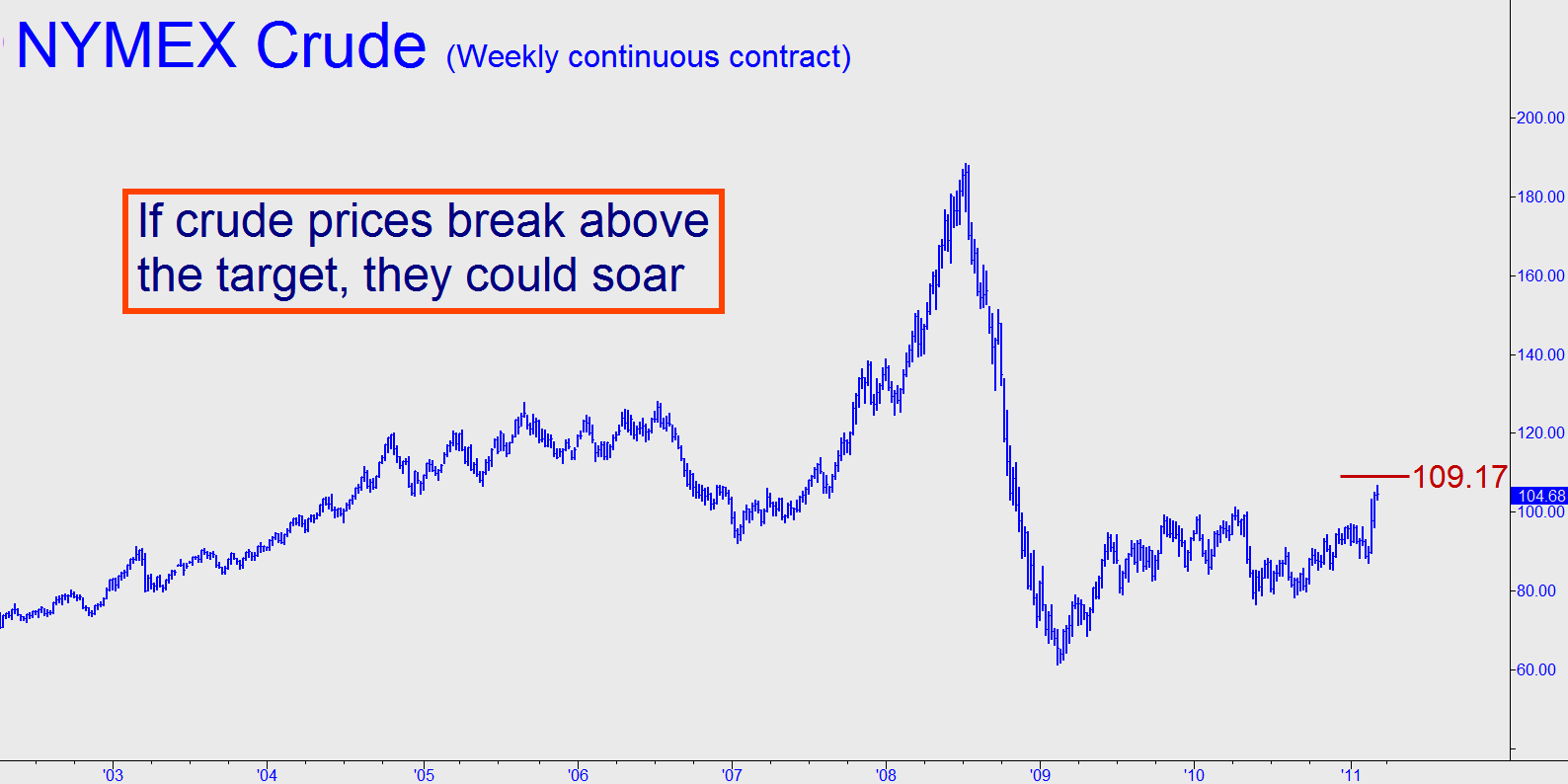
The “experts” would indeed have us braced for the worst. “Although most political analysts predict any demonstrations to be swiftly – and perhaps bloodily – suppressed by the government,” the Financial Times reported, “any hint that the protests enjoy wider-than-expected support is likely to spook investors once again.” We suspect that even if Riyadh remains relatively peaceful, however, that crude oil prices will continue to head higher. A short while back, we wrote here that the spike in crude caused by mounting troubles in Egypt and Libya would seem relatively tame in comparison to what we might see if Saudi oil production were to come under threat. While we still think that’s true, we now expect a quiet weekend in Saudi Arabia to ultimately have little impact on energy markets that seem likely to remain in the grip of speculators. They are quite obviously determined to keep squeezing until the fever breaks, but will it? The Saudi demonstration is not the only one planned for today. There’s another in Bahrain, where Shia protestors are planning to march on the Sunni-dominated royal court in Riffa. That doesn’t sound like a very mellow mix. And in Libya, the battle could drag on indefinitely, perhaps turning even uglier if the country’s energy resources come under attack in an escalated conflict.
Learn Rick's 'uncannily accurate' Hidden Pivot Method at our next webinar. Save $50 by 3/31. Use coupon code 7D5629Prohibitive Air Fares
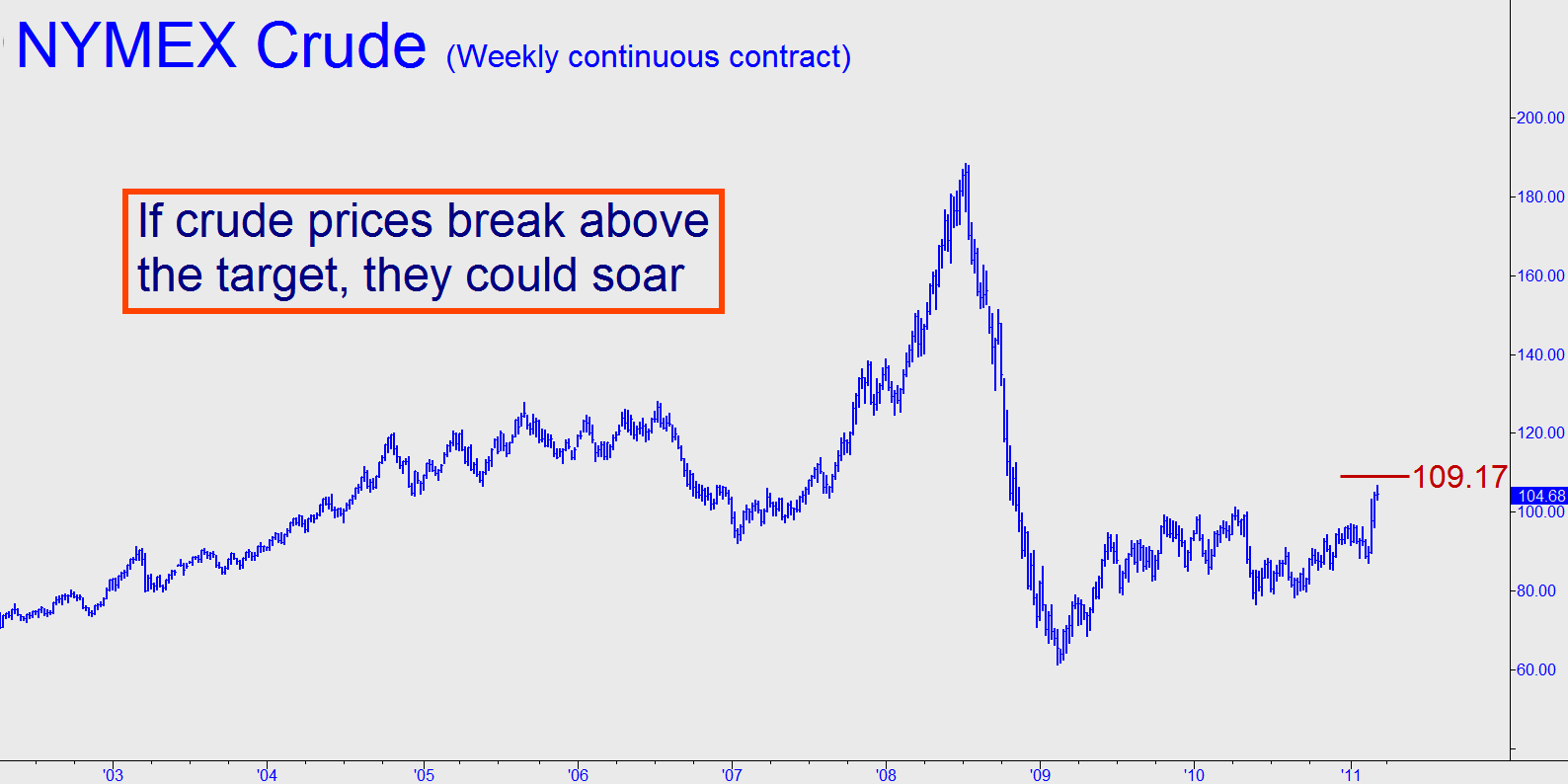
Concerning the technical picture for crude oil futures, we are currently using a Hidden Pivot target at 109.17 as a minimum upside projection for the NYMEX continuous contract. So far, it has gotten as high as 106.95. If the pivot fails to contain the rally, however, the breakout could go all the way to $151 before it hits a pocket of supply deposited on the charts as crude fell from a frenzied, all-time peak at $188 recorded in the summer of 2008. Even if this Middle East-driven short-squeeze does not break any price records, the persistence of tensions in the region is apt to keep quotes quite buoyant for the foreseeable future. Under the circumstances, we should tune out the ostentatious sighs of relief on Wall Street whenever stocks rise on a day when oil prices have fallen. The two are connected, for sure, but any bullishness based on cheaper crude is bound to be short-lived. Fuel costs have already pushed air fares so high that airports are going to seem relatively deserted this summer. How will the stimulus-addled stock market react if gasoline is headed toward $5 a gallon, as seems plausible?
(If you’d like to have Rick’s Picks commentary delivered free each day to your e-mail box, click here.)

Tuesday, 8 March 2011
Will The Day Of Rage In Saudi Arabia On March 11 Send The Price Of Oil Into Unprecedented Territory?

The price of oil is shaping up to be the number one economic story of 2011, and right now the eyes of the investing world are closely watching the developing situation in Saudi Arabia. All of the other recent Middle East revolutions have been organized on the Internet, and now all over Facebook and Twitter there are calls for a "Day of Rage" in Saudi Arabia on May 11. The Saudi monarchy is attempting to head off any protests by promising to give $37 billion in "benefits" to the people and by publicly proclaiming that all political demonstrations are specifically banned. In addition, the Saudi government is stationing thousands of security forces at various potential "hot spots" around the country. So far similar measures have not done much to quell unrest in other nations in the Middle East, but Saudi Arabia will be a true test of the revolutionary fervor that is sweeping the region. The Saudis have a long history of brutally repressing their own people. They simply do not mess around. So a revolution in Saudi Arabia will not be nearly as "easy" as it was in Tunisia, Egypt or Libya. However, if a revolution does sweep across Saudi Arabia, it is going to send the price of oil into unprecedented territory. Saudi Arabia is the number one exporter of oil in the world, and if their oil fields get shut down even for a little while it is going to have a dramatic effect on the global economy. With the world already on the verge of a major sovereign debt crisis, the last thing it needs is for the price of oil to start soaring into the stratosphere.
Right now the investing world is not sure what to think about all of this, and financial markets do not like uncertainty. One piece of really bad news could send markets all over the globe crashing down.
Speculation in oil futures is absolutely rampant. A recent report on CNN noted the following....
The speculative fervor is so remarkable that the big trading firms now have nearly twice as many long contracts open as they did in 2008, when oil spiked to $147 in the summer, a development that either foreshadowed or caused the global economic meltdown, depending on how you look at it.
In particular, the number of investors that are betting that a revolution in Saudi Arabia is going to send the price of oil up to $200 a barrel has exploded in recent days.
$200 a barrel?
Are people actually betting that is going to happen?
The all-time record is only $147 a barrel. Just a few months ago it was absolutely unthinkable to most economists that we could potentially see $200 oil in 2011.
But it would be a mistake to assume that a full-blown revolution is guaranteed to break out in Saudi Arabia. Remember, this is a nation that has a very, very long history of denying even the most basic freedoms to the people.
For example, in Saudi Arabia the practice of any religion other than Islam is strictly forbidden. By law, citizens of Saudi Arabia are not permitted to change religion. Even foreign visitors are forbidden to openly practice any other religion. It is a whole different world. You cannot go to the store and buy a Bible in Saudi Arabia. In fact, if you try to pass out Bibles in Saudi Arabia you will be thrown into prison.
Beheadings and other brutal public executions still happen in Saudi Arabia to this day.
So if you plan of being a revolutionary in Saudi Arabia you had better put your big boy pants on, because the Saudis play hardball.
Much of the rest of the globe is desperately hoping that a revolution does not happen in Saudi Arabia because the global economic situation is precarious at best.
In Europe, if the price of oil causes a significant economic slowdown right now it could have global implications. Moody’s Investors Service just slashed Greece’s debt rating three levels all the way down to B1. But Greece is far from alone. Several European governments are finding it much more expensive to finance their debts these days. We are right on the edge of a major European sovereign debt crisis and the chaos in the Middle East could potentially be just the thing to spark a panic.
The United States could feel a rise in the price of oil even more than Europe because the U.S. economy is so spread out and it is so dependent on products from overseas.
Did you know that in 1960 only 8 percent of the things Americans bought were made overseas but that today 60 percent of the things Americans buy are made overseas?
It's true.
So what would happen if the cost of transporting all of those products suddenly doubled? All of the products we buy must be transported somehow, and a rise in transportation costs will be passed on to U.S. consumers.
But the truth is that the pain is already here. Already, millions of American families are starting to feel some very real financial pain from the chaos in the Middle East.
From February 18th to March 4th, the average price of gasoline in the United States rose 33 cents. That was the biggest two week increase ever recorded.
Ouch.
The rise in the price of oil has some broader economic implications as well.
The more the price of oil goes up the bigger our trade deficit is going become. As the trade deficit gets bigger, that means that more money is going out of the country and less money is going to support American businesses and American workers. When American workers lose jobs, that means that they aren't producing wealth anymore and they aren't paying taxes anymore. Instead, they become a drain on the system as they start receiving government handouts.
When millions of Americans go from being productive, taxpaying workers to unemployed welfare cases it causes our federal budget deficit to become even larger.
Most Americans do not understand how connected our trade deficit and our federal budget deficit really are. One feeds right into the other.
Unfortunately, the Federal Reserve seems to think that the solution to any economic problem these days is to print more money.
According to Atlanta Fed President Dennis Lockhart, if the price of oil goes up high enough, it could force the Federal Reserve to do even more quantitative easing.
Really?
One of the reasons why the price of oil and other commodities has been going up over the last six months is because of all of this reckless money printing.
Now Lockhart is saying that because of the oil price increases they may have to do more money printing?
How bizarre is that?
Unfortunately, several other top Fed officials have dropped hints about a possible "QE3" lately. It just seems like the insanity never stops.
Let us hope that the Fed does not go there because the U.S. dollar is falling apart fast enough already.
In any event, the rest of 2011 is certainly going to be very interesting to watch.
Even if a revolution does not happen in Saudi Arabia, the price of oil will most likely continue to slowly move higher just as it has been doing for months.
But if a full-blown revolution does happen in Saudi Arabia, it could literally change the global economy almost overnight. The entire world financial system would be thrown into a state of chaos.
Oil is the lifeblood of the world economy. Without a continuous supply of very inexpensive oil, life as we know it would dramatically change. Most of us just assumed that we would always live in a world where we would always have an endless supply of very cheap oil.
Well, the times they are a changing.
You had better buckle up because it is going to be a bumpy ride.
Sunday, 6 March 2011
The Truth Behind Saudi Arabia’s “Spare Capacity”

03/04/11 Baltimore, Maryland – Crude oil topped $103 this morning.
The last time oil was this high was Sept. 26, 2008 – the last trading day before the US House rejected the first bank bailout bill. Wall Street then threw a snit and slashed 777 points off the Dow in one day.
Good times.
There doesn’t appear to be any overt reason why the price popped today. But beneath the surface, we see a series of ominous developments from Saudi Arabia, the world’s No. 1 oil exporter. Events that could make $103 oil seem as quaint as an 8-track tape left in an abandoned car for the last 40 years.
First, a little background. World energy demands – and, by extension, traders in the market – rely on something called “spare capacity” or producers’ ability to jump-start new oil production within 30 days and keep it up for at least 90 days.
If you listen, you’ll hear it on the tip of the “official” tongue. Yesterday, for example, Treasury Secretary Tim Geithner assured Congress: “It’s important to note that there is considerable spare oil production capacity globally.”
“Spare capacity” in the oil market is directly analogous to the bag of tricks Ben Bernanke alluded he’d dip into when the time comes to unwind the Fed’s balance sheet.
For better or worse, most of the “spare capacity” burden falls on Saudi Arabia. Saudi princes claim to be able to goose production from 9 million barrels a day to 12 at the drop of a hat.
Never mind that they’ve never done anything like that before, even when oil ran up from $25 to $147 a barrel between 2003-08. The official line – and, therefore, the oil market – still believes it’s true.
But for how long? This chart from Morgan Stanley, analyzing worldwide demand estimates, suggests “spare capacity” will be tapped out in two short years.

Even by conservative demand assumptions, “spare capacity” disappears by 2013…
As fighting was getting under way in Libya a week ago, Saudi Arabian oil officials got on the phone to the International Energy Agency (IEA). They’d just boosted their daily oil production from 8.6 million barrels a day to 9 million. They wanted the world to know they could step in with the “spare capacity” to replace Libyan production.
Oil prices dropped in the final half-hour of trading.
Amazing, isn’t it? Saudi Arabia’s stated reserves are 259 billion barrels. Which is what they were last year…and every year going back to 1980.
In his book Twilight in the Desert, the late Matt Simmons, a gentleman with whom we shared an editor at John Wiley & Sons, found ample reason to cast doubt on official Saudi figures during the previous decade. WikiLeaks made public last month that a senior official from the state-owned oil company believes Saudi reserves are overstated by 40%.
And yet the market responded to what was effectively a PR campaign by the Saudi princes.
“There is in fact good reason to think that the Saudis are producing 9 million barrels a day,” says author Steve LeVine, writing at Foreign Policy, “but reasonable doubt that they went up to that level just last week in response to Libya.”
More likely, they boosted production some time ago to help meet domestic demand.
“If they were producing that much then,” LeVine says, “it does not necessarily prove that they can raise their production now, neither for the many months before full Libyan production returns to the market.”
The Saudis have also made public plans to start injecting carbon dioxide into the world’s largest oil field, Ghawar, no later than 2013. CO2 injection is what you do when an oil field starts yielding progressively less oil. It gooses the output…for a little while.
The plans come as no surprise from the Saudis, given Ghawar was discovered in 1948.
Even if the Saudi princes are telling the truth about their spare capacity, it all goes bye-bye in two more years. The fact that they’re resorting to complex and costly new tactics to keep the world’s largest oil field creaking along doesn’t exactly inspire confidence.
Bottom line: “Saudi Arabia can’t make the shortfall from Libyan supplies,” says commodities investing legend and Vancouver veteran Jim Rogers. “They’ve said in the past that they can increase production, but they can’t.”
Addison Wiggin
for The Daily Reckoning

Addison Wiggin is the editorial director of The Daily Reckoning, and executive publisher of Agora Financial, an independent financial research firm based in Baltimore, Maryland. His second editions of international best-sellers Financial Reckoning Day Fallout and The New Empire of Debt, which he co-authored with Bill Bonner, were updated in 2009. His third book, The Demise of the Dollar… and Why it’s Even Better for Your Investments was updated in 2008, the same year he wrote I.O.U.S.A. ??
Wiggin is the executive producer and co-writer of I.O.U.S.A. an acclaimed documentary nominated for the Grand Jury prize at the 2008 Sundance Film Festival and the 2009 Critics Choice Award and shortlisted for a 2009 Academy Award. Wiggin is a three-time New York Times best-selling author whose work has been recognized by The New York Times Magazine, The Economist, Worth, The New York Times, The Washington Post as well as major network news programs.
View articles by Addison Wiggin The articles and commentary featured on the Daily Reckoning are presented by Agora Financial.Sign Up for The Daily Reckoning e-letter and receive a copy of our newest report How to Survive the Fall of Social Security… at NO CHARGE.
We Will Not Share Your Email.
We Value Your Privacy.
Subscribe to:
Posts (Atom)