This session was open to all Rick’s Picks subscribers, since the focus was on leveraging a cluster of Hidden Pivots that, taken together, strongly hint of an important top. We traced the provenance of two such targets in the E-Mini S&P and also found a new one in the Mini-Dow at 12409. Not wanting to waste the opportunity presented by a possible last-gasp rally, we looked for camouflage entry spots for bullish trades in the mini-index futures. Even if the stock market doesn’t collapse after hitting our targets, we expect to make money on short trades by managing risk scrupulously.
Showing posts with label Short. Show all posts
Showing posts with label Short. Show all posts
Friday, 1 April 2011

Preparing to Short a Top
This session was open to all Rick’s Picks subscribers, since the focus was on leveraging a cluster of Hidden Pivots that, taken together, strongly hint of an important top. We traced the provenance of two such targets in the E-Mini S&P and also found a new one in the Mini-Dow at 12409. Not wanting to waste the opportunity presented by a possible last-gasp rally, we looked for camouflage entry spots for bullish trades in the mini-index futures. Even if the stock market doesn’t collapse after hitting our targets, we expect to make money on short trades by managing risk scrupulously.
Wednesday, 23 March 2011
Desperation: Food, Water, Fuel, Electricity Run Short In Japan

It’s been ten days since the Tsunami swept through Japan and wiped out the entire infrastructure of the North Eastern part of the island. Like the US, just-in-time delivery made essentials like food and water as easily accessible as air. But when the grid goes down in an economy so dependent on inventory management, transportation, and electronic debit transactions, all hell breaks loose. Nearly two weeks on, the people in areas affected by the Tsunami and nuclear crisis have seen little relief. Many are just struggling to survive on a few hundred calories per day.
In another time, another place, Kazuhiro Takahashi could be taken for a tramp, out scavenging for food after a long night on the bottle. In fact, he is just another hungry victim of Japan’s tsunami trying to find food for his family.
“I am so ashamed,” says the 43-year-old construction worker after he realizes he’s been spotted. “But for three days we don’t have enough food. I have no money because my house was washed away by the tsunami and the cash machine is not working.”
If his haul wasn’t so pitiful – his bag had two packets of defrosted prawn dumplings and a handful of vacuumpacked seafood sticks inside – Takahashi might be taken for a looter. But in the port town of Ichinomaki, 320 kilometres north of Tokyo, his story is disturbingly common.
Japan might be a rich country, but a week after the tsunami struck it is struggling to feed and house the victims.
“I have a place in a rescue centre in the Aka’i Elementary School, but the food they are giving us is not enough,” Takahashi says. “My parents are in their 70s and we receive a tiny bowl of plain rice twice a day, with nothing else, just a pinch of salt. We are hungry, so I have come to look for food.”
Source: The Gazette
—
Gas station queues stretching for several kilometres, long waits at supermarkets, empty store shelves and shuttered businesses have become a part of the landscape in post-tsunami Japan.
At the foot of the Mount Iwate volcano, the people of Morioka city — almost 100 kilometres (60 miles) west of the devastated coast — are still trying to adjust to the sudden absence of many things they had simply taken for granted.
At a gas station on the outskirts of the city, motorists waited hours on end before finally reaching the gas pump, clutching a 2,000 yen ($25, 17 euros) daily rationing coupon in their hands. The coupon is barely enough to buy a third of a tank on an average-sized city car.
…
“There are no more meat and vegetables. I’m eating instant meals all the time,” said Naohiko Seki. “I would like to regain my old life, but when I think about people who suffered from the tsunami, I tell myself I shouldn’t complain.”
…
Convenience stores, usually open around the clock, had row after row of empty shelves, where prepared foods like the normally ubiquitous ‘onigiri’ rice balls, water and milk products once stood.
…
“It’s really strange. The stores have almost no baby food and other items. It makes me uneasy and anxious. I am worried because I don’t know whether or not I will be able to buy what my child needs,” he said.
Source: AFP
Author Naseem Talib calls it a black swan – an extraordinary event so remote that one cannot plan or prepare for it. Donald Rumsfeld once described events in the Iraq war as “known unknowns” and “unknown unknowns.” The only thing we really do know with respect to disaster planning is that sometimes we just can’t know what to expect due to lack of available information or contemplation.
For those in Japan, even a cache of food, water, gas, and other reserve supplies would not have been enough. Many homes were simply wiped away, leaving residents with literally nothing but the clothes on their backs. In this situation, desperation sets in quickly. And without a local emergency response, or a culture of support, social norms, laws and decency can dissolve within days.
The Japanese, unlike disaster victims we’ve seen in other crisis regions like New Orleans or Haiti, have been handling themselves as well as they can, without much violence or reports of looting. Emergency responders, government and the private sector have not been completely ineffective, and have managed to keep the flow of commerce moving to those parts of Japan most affected, albeit not at the pace most would expect from a leading global player.
In Japan, ATM machines are down, and banks are closed in Tsunami areas and nuclear evacuation zones. This means that unless you had cash or something of value on your person at the time the disaster struck there is no way to acquire whatever goods are available without government assistance. Even within a technologically advanced society like Japan, however, even the basics become difficult to distribute for emergency responders and military personnel when we’re talking numbers in the millions of people.
In his book Indivisible, author Troy Grice writes of a ration-card solution that keeps commerce moving during a US dollar currency collapse. Grice wasn’t too far off in his fictional account. In response to the wide-spread regional disaster, the Japanese government has issued ration cards, which are seemingly the only viable course of action in the first world when the monetary unit of exchange, in this case the Yen, becomes unavailable.
Unlike the first few days of Katrina, where residents had no access to clean water or food, or Haiti, where gangs roamed the streets looking to loot and pillage essential supplies, the Japanese have been able to restore some of theirinfrastructure, namely food, water, limited gasoline and the sense that the country is starting to move forward.
Save a further degradation of the nuclear situation, the very worst – those initial days after crisis where families lost loved ones and food and water were unavailable – may be behind the people of Japan.
The Japanese people, it seems, have been able to hold strong. At least that’s what reports from the devastated region suggest thus far. Those who are of the ability to help have been doing so, as it is clear that the government is totally overwhelmed. Any nation whose people can respond by working together, by sharing, by comforting each other, will undoubtedly recover. Johann Hari, writes, in The myth of the panicking disaster victim, of how human beings have responded to disasters throughout history:
The evidence gathered over centuries of disasters, natural and man-made, is overwhelming. The vast majority of people, when a disaster hits, behave in the aftermath as altruists. They organise spontaneously to save their fellow human beings, to share what they have, and to show kindness. They reveal themselves to be better people than they ever expected. When the social scientist Enrico Quarantelli tried to write a thesis on how people descend into chaos and panic after disasters, he concluded: “My God! I can’t find any instances of it.” On the contrary, he wrote, in disasters “the social order does not break down… Co-operative rather than selfish behaviour predominates”.
On 18 April 1906, San Francisco was levelled by an earthquake. Much of the city collapsed, and the rest began to burn. Anna Amelia Holshouser – a middle-aged journalist – was thrown out of bed, and felt her house collapse around her. She wandered the streets, and found herself sleeping that night in the park. But then the daze wore off, and she did what almost everybody else did: she began to look after the people around her. She knitted tents out of old clothes to house all the children who had lost their parents. She set up a soup kitchen, and the local shop-keepers handed over the goods for free. Hundreds of people gathered there, as they were gathering around similar people across the city. Anna put up a sign that said: “One Touch of Nature Makes the Whole World Kin.
Hat tip Aussie Suzy, Rense.com

Monday, 21 March 2011
Long Oil, Short Stocks!
“Go long oil, short stocks!” is what we advised subscribers to do on Friday, with Col. Qaddafy declaring a cease-fire and Japan laboring heroically to contain the menace of contamination from damaged spent-fuel rods. Sketchy news concerning a Libyan truce had caused crude-oil quotes to recede somewhat from their frenzied peaks, but we could think of no convincing reason why Kadhafy would actually stand down. On the contrary, we assumed that he was stalling in order to consolidate gains on the ground before the “international coalition,” whoever they might be, enforced a no-fly zone. This they did over the weekend — with France, of all countries, spearheading the attack from the air. It’s hard to imagine what the “coalition” has in mind — other, perhaps, than cutting the rebels a little slack. But a little slack is as much as they’re likely to get, since it seems doubtful the allies will commit the ground troops needed to shut down Qaddafy’s offensive.
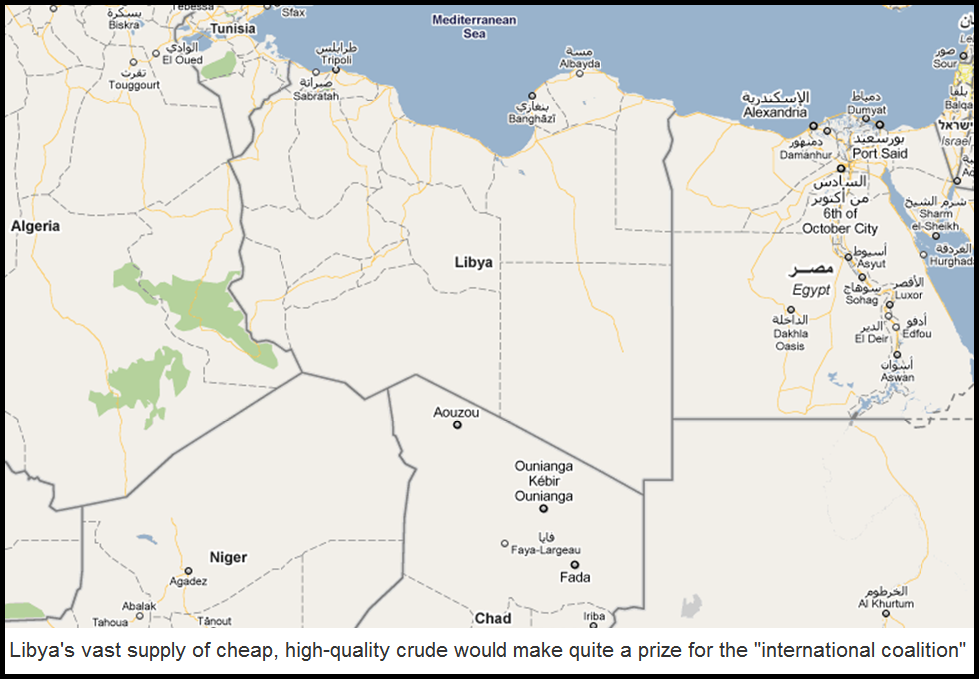
In admonishing subscribers to “Buy crude!” we asserted that the “international coalition” may have made the mistake of boxing in a ruthless and paranoid dictator. Notice that we did not call him a ruthless, paranoid and unpredictable dictator. For not even the U.S. State Department, never mind the military brass, could expect Col, Qaddafi to simply roll over, running up the white flag and effectively ceding control of Libya’s oil fields to such worthies as France, the U.S. and whoever else signed on to the weekend air sorties. Far more likely, in our estimation, is that Qaddafi would sabotage Libya’s oil capacity before he’d turn it over to the West. What’s to stop him? We surely don’t envision French troops on the ground, hanging tough with the rebels. And that is why we asserted on Friday that anyone who went home short crude oil futures would get what they deserved come Monday morning. Actually, as of Sunday night, the May contract was up more than $2 and looking feisty enough to go even higher.
The ‘Wrong’ Catastrophe
Concerning part two of our recommendation – “Short stocks!” – gratification could be a little longer in coming. We were bearish on stocks not because we feared a catastrophic nuclear meltdown; indeed, as a highly technical article that we linked at Rick’s Picks last week explained, the Fukushima reactors were all shut down at the time of the earthquake, effectively limiting the amount of any damage that could occur. No, what concerned us most was not radioactive fallout, but economic fallout caused by the crippling of the world’s most important just-in-time producer. Auto-parts users around the world, for one, are already feeling the strain of Japan’s outage; however, shortages in many other key areas of global production are bound to be felt, and soon.
Learn Rick's 'uncannily accurate' Hidden Pivot Method at our next webinar. Save $50 by 3/31. Use coupon code 7D5629This developing story has been underplayed so far, but it seems inevitable that Japan’s economic slowdown will negatively impact a global economy that was already skirting depression. Why have the news media emphasized the nuclear scare-story over the perhaps even scarier economic one? On that question, we defer to our colleague Bill Buckler, publisher of The Privateer. He notes that the one asset class that has benefited from nuclear-disaster talk is U.S Treasury paper, which the contemptible idiots who bring us the news each day persist in calling a “safe haven” – the safest of havens, actually. Yeah, right. With the U.S. Treasury already $14.3 trillion in the hole, Congress has throttled back on spending to the tune of about $3 billion. If you believe in the tooth fair, then every U.S. bond- and note-holder is going to get paid. For our part, we’ll cast our lot with PIMCO, which recently bailed out of Treasurys as “too risky.”
Moody’s a ‘Useful Idiot’
That is notwithstanding the fact that the U.S. has the unquestioning help of some useful idiots in sustaining a brazen fraud that ranks U.S. Treasury paper as the absolute safest of safe havens. There is Moody’s, for one, which can always be counted on to downgrade Europe’s sovereign paper whenever investor scrutiny might otherwise fall on U.S. debt. And there’s also G-7, ever eager to dig itself in deeper to protect the mountain of bogus U.S. paper its members hold. Most recently, they helped Geithner throw everything they could at the yen to hold it down. Indeed, if the short-squeeze on yen carry-traders had grown any more intense than it did last week, it would have forced a massive unwinding out of Treasurys, derivatives and everything else that banking’s feather merchants have bought using yen borrowed for next to nothing.
The epic folly that sustains this hoax could last for yet a while longer. However, we are convinced of one thing: It cannot last forever.
(If you’d like to have Rick’s Picks commentary delivered free each day to your e-mail box, click here.)

Subscribe to:
Posts (Atom)